

You do not need to order every available grit simply because a diamond sponge polishing pad comes in a full range. For a replacement purchase, identify the exact pad series, diameter and grit you need. For a new polishing process, establish the sequence for the actual stone and machine before buying.
Monkey King diamond sponge wet polishing pads are available in 3-, 4-, 5-, 6-, 7-, 8- and nominal 12-inch sizes, with the largest option specified as 300 mm. Each pad is 12 mm thick with a 20 mm centre hole. Grit options are 150, 300, 500, 1000, 2000, 3000, 5000, 6000 and 10000. Pads are sold individually in the selected size and grit.
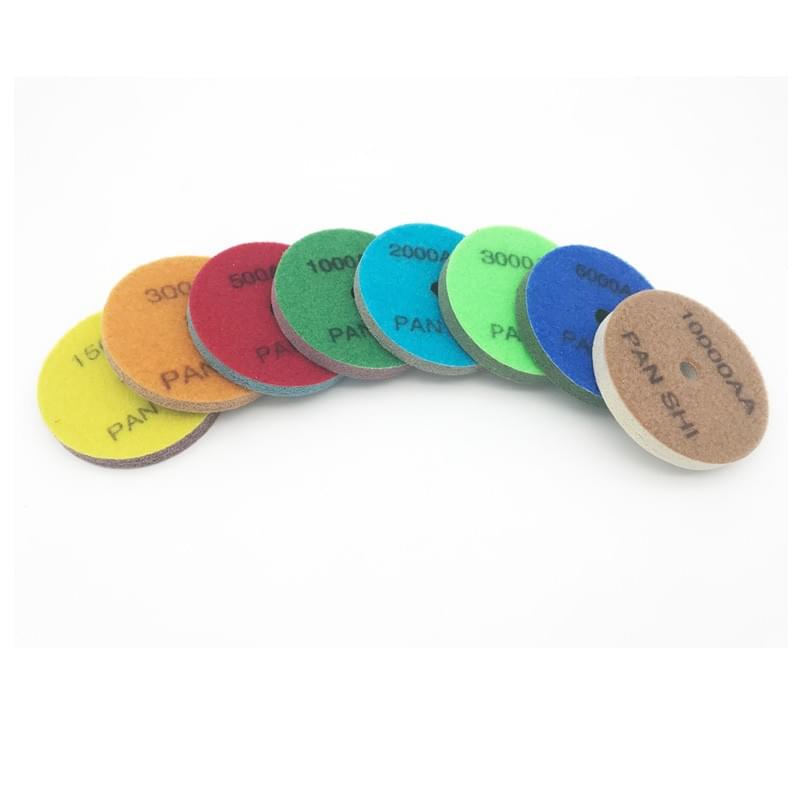
Two orders for the 300 mm version illustrate why individual grit options matter.
One buyer ordered two 150-grit pads. Another ordered one pad each in 500, 1000 and 3000 grit.
These are purchase records, not documented polishing trials. They do not tell us which machines the buyers used, what condition their stone was in, or which other pads they already owned. The three grits in the second order should therefore not be presented as a complete recommended polishing sequence.
The useful purchasing lesson is simpler: buyers do not always order the same quantity of every grit. A single-grit order and a mixed-grit order are both different from purchasing an entire range.
Replacing One Grit Is Different From Starting a New Process
When replacing a pad in an established process, start with the specification of the pad being replaced. Match the product series, actual diameter, grit marking and backing arrangement.
Do not choose a replacement from its colour alone. Confirm the written specification, especially when changing suppliers or comparing two products described as “diamond sponge polishing pads.”
If you are starting a new marble or granite polishing process, a previous customer's order is not a substitute for a suitable sequence. Identify the stone, its current surface condition, the preceding abrasive step and the intended finish.
Treat the available grit range as a purchasing menu—not as an instruction to use every grit on every job. Likewise, the availability of a 10000-grit option is not a promise that it will produce the required finish on an inadequately prepared surface.
For broader comparisons between polishing-pad formats, our diamond polishing pad and machine-selection guide provides additional context. It does not replace the instructions for this particular sponge-pad series.
Match the Diameter Before Comparing Grits
A 500-grit pad in one diameter is not an automatic replacement for a 500-grit pad in another diameter.
Choose the pad size by checking the actual machine and holder. Confirm the outside diameter, backing connection, centre opening, working clearance and permitted operating conditions.
This Monkey King series has a specified thickness of 12 mm and a 20 mm centre hole across the listed sizes. Those dimensions are useful purchasing references, but they do not establish compatibility with every polishing machine.
The nominal size is only the starting point. In particular, use the stated 300 mm diameter when checking the largest pad against your holder rather than treating “12 inch” as a precise dimensional conversion.
The backing plate, holder, adapter and polishing machine are not included. Before ordering several pads, resolve the connection details for the exact size you intend to use.
Keep Stone Polishing Separate From Concrete Tooling
This series is offered for staged wet polishing of granite, marble and compatible stone surfaces. It is separate from our larger concrete and terrazzo sponge-pad range.
The word “sponge” does not make different pad families interchangeable. A stone-polishing pad and a concrete or terrazzo maintenance pad can share a broad product name while having different specifications.
Similarly, do not transfer a grit sequence from another polishing-pad family simply because the grit numbers look familiar. Check the product series and intended application before treating one pad as an alternative to another.
When browsing our stone-processing tools and accessories, start with the material and task you need to complete—not just a familiar product name.
Confirm Wet Use and the Complete Setup
This diamond sponge pad series is specified for wet polishing. Follow the operating instructions for the selected pad, holder and machine; wet-use suitability does not establish dry-use suitability.
A pad purchase should describe the complete setup clearly enough to avoid a mismatch. “Five-inch sponge pad” leaves important questions unanswered if the required connection, centre opening or operating conditions have not been checked.
For a replacement order, reference the existing Monkey King pad specification. For a new setup, provide the machine model and holder details together with the stone material and the stage you need to complete.
An application example is useful context, but it is not confirmation of fitment for every handheld polisher, flat-polishing machine or edge-polishing machine.
Order the Pads Your Process Actually Requires
Before placing an order, distinguish between replacing a known pad, replenishing several grits and building a new polishing sequence.
For a known replacement, specify the exact diameter, grit and quantity. An order quantity of one means one pad in the selected size and grit—not a complete polishing set.
For a new process, confirm the application before selecting a group of pads. Do not copy the two order examples above as a jobsite recipe. If the connection or application is unclear, ask Monkey King Diamond Tools to review your setup before purchasing.
Ready to replenish your tooling? Choose the required size and grit of Monkey King diamond sponge polishing pads, then check the selected variant and quantity before checkout.