

Some repeat orders are more useful than long conversations. This one was simple and honest.
A contractor in Alabama first tested a heavy-cut grit and said it “functioned perfectly.” Then he moved straight to the next pain point: “Clockwise cut… removing thinset on some jobs and several coats of epoxy with quartz on others… pads with tungsten wear bars are not aggressive enough.”
That’s the moment most coating-removal workflows either get faster — or get messy.
Setup A: Clockwise PCD (when removal must “bite”)
If your problem is thinset residue or epoxy with quartz broadcast, and scraper-style wear bars aren’t aggressive enough, clockwise PCD is usually the cleanest first step. Direction matters because PCD is directional tooling: match the grinder rotation to the tool direction to reduce pull and improve control.
Use case: thinset removal, epoxy/quartz coating removal, glue/mastic stripping.
Recommended page (verified): Lavina PCD coating removal tool with CW/CCW option.
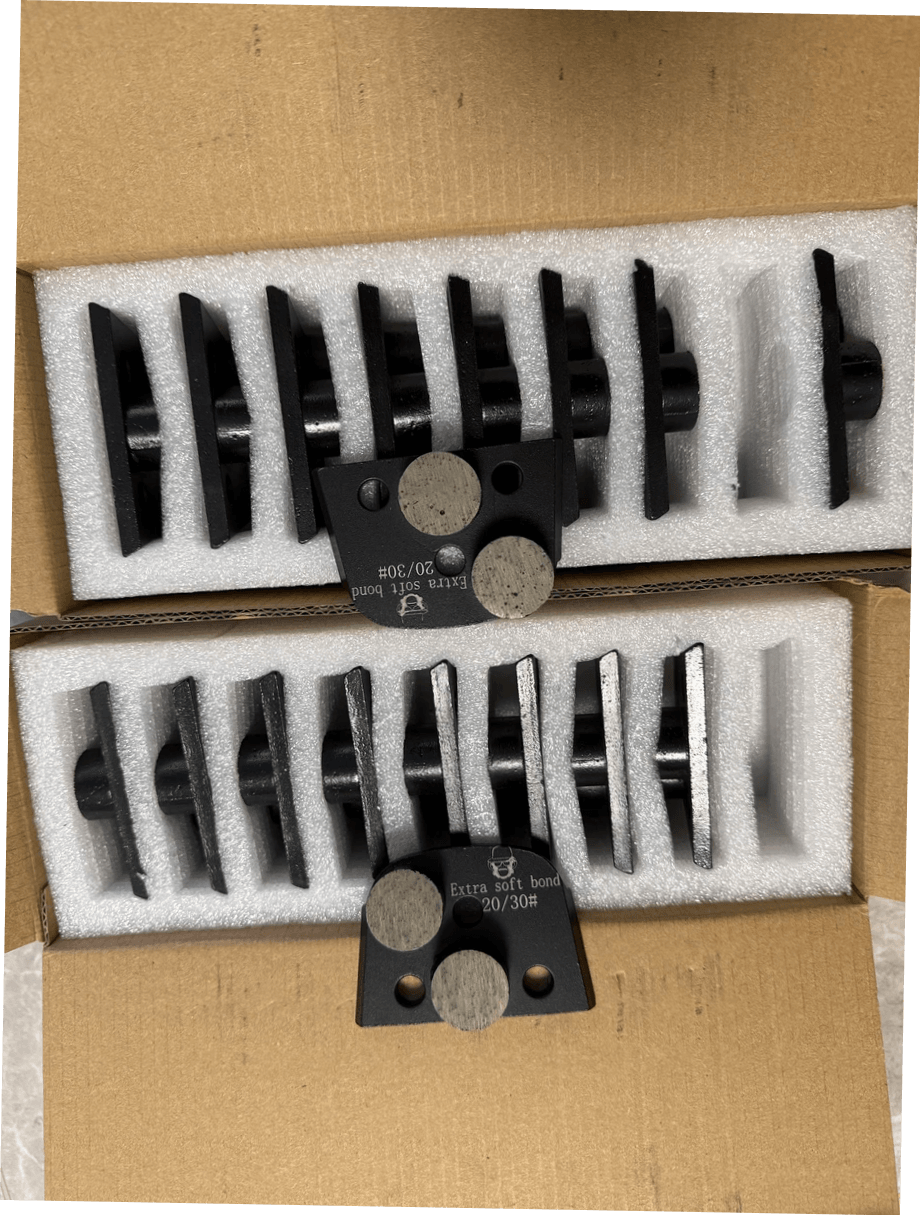
Setup B: 20/30 Extra Soft Bond (when you must cut the concrete itself)
This is a different job. The goal isn’t “remove soft material.” The goal is to cut extra-hard concrete (including slabs cured with curing compounds), shave down high spots, and still leave enough profile so low areas bond well under epoxy.
That’s where 20/30 grit + extra soft bond helps: on very hard slabs, a softer bond can expose diamonds faster and keep the tool cutting instead of skating.
How to choose between A and B (fast decision rule)
- If you’re mainly fighting thinset/epoxy/quartz coating that won’t release → start with clockwise PCD.
- If the slab itself is extremely hard and you must cut/flatten high spots for epoxy prep → start with 20/30 extra soft bond metal diamonds.
Jobsite requirements (to avoid problems)
- Keep the machine moving; avoid parking in one spot (reduces gouging).
- Test a small area first to feel pull/chatter and confirm the profile you want.
- Plan the next step: after removal, most crews switch to metal grinding to control scratch pattern and flatten the surface.
Related pages