

A customer in Spain ordered six Cassani-type hard diamond polishing pads: three pieces in 50 grit and three pieces in 100 grit.
It is a focused two-grit order for early floor refinement. It is not enough information to claim a complete polishing process, guaranteed machine fit, or a specific finished result.
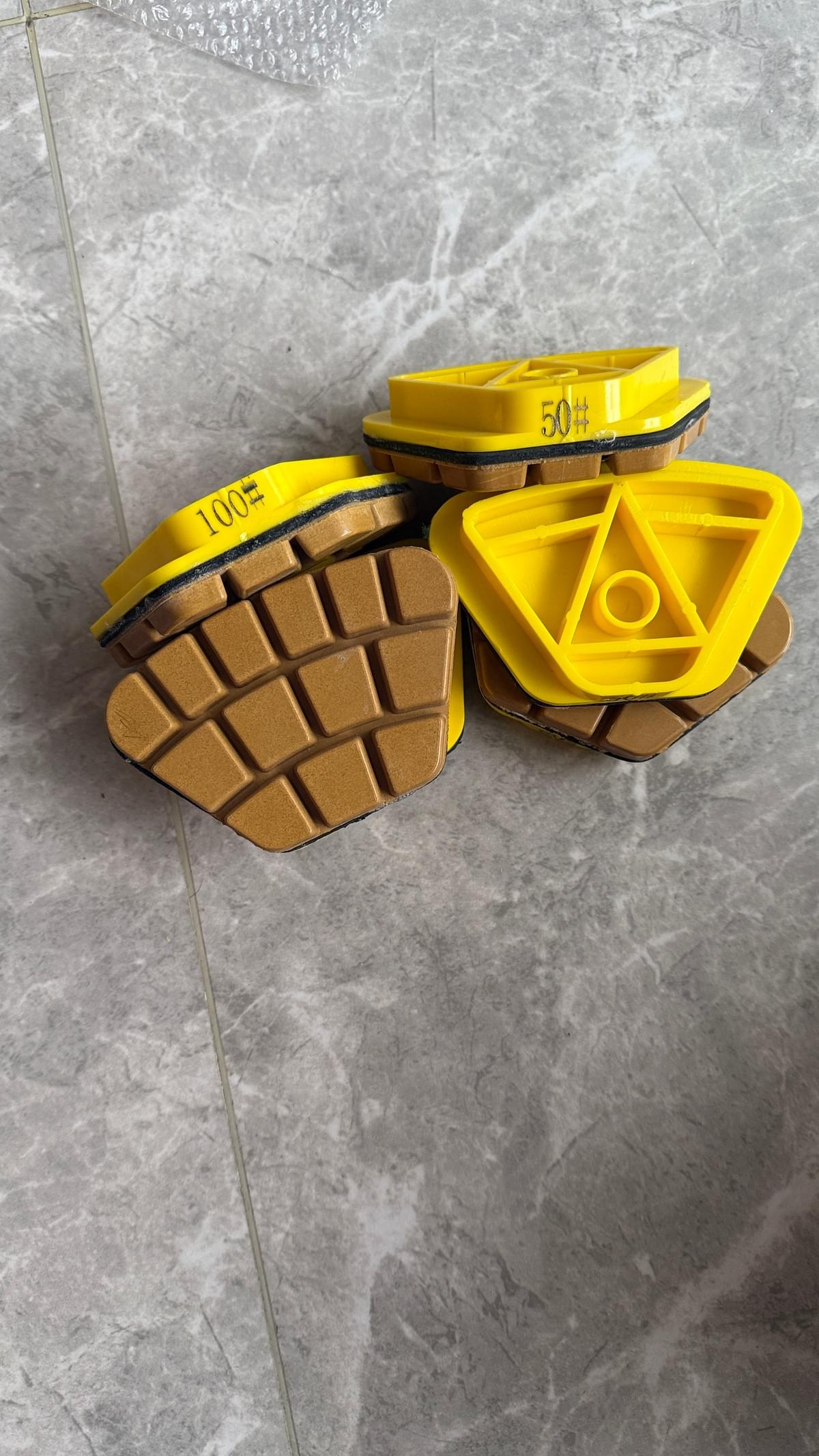
Three 50-grit and three 100-grit Cassani-type hard diamond pads prepared for a Spain customer order.
What This Spain Order Contains
The order is balanced across two consecutive grits.
Three pads are marked 50 grit. Another three pads are marked 100 grit. The photograph shows the segmented working faces and the yellow Cassani-type backing shape.
What the order does not tell us is equally important. The machine model, holder dimensions, floor material, previous abrasive step, wet or dry process, and required final finish were not recorded in the information available for this article.
Those details must not be invented from the pad appearance or destination.
How 50 and 100 Grit Work as a Sequence
Within the same product family, 50 grit is the coarser of the two selected steps. It can be considered when the surface still requires an earlier refinement stage after the preceding floor preparation work.
The 100-grit step is finer. It should follow only after the operator confirms that the 50-grit stage has produced an even and controlled scratch pattern.
Moving from 50 to 100 should be based on the floor result, not only on elapsed polishing time. The surface should be cleaned and inspected before the next grit is installed. If deeper marks from an earlier tool remain, changing to 100 grit does not prove that those marks will be removed.
For later-stage refinement and finish development, buyers can compare other resin polishing pad options according to the floor material, preceding scratch pattern, working method, and target finish.
Why This Is Not a Complete Polishing System
A two-grit purchase can have several legitimate purposes. It can supply the early part of a longer sequence, replace worn tools already in use, or provide a small test quantity before a larger order.
The available order information does not establish which of those purposes applies here.
The product range also includes 200, 400, 800, 1500, and 3000 grit. That does not mean every project must automatically use every available grit. It also does not mean a floor can stop at 100 grit and be described as fully polished.
The correct stopping point depends on the floor material, its condition after each step, and the finish required by the project.
Three Pads per Grit Does Not Prove Machine Fit
The quantity is clear: three pieces of 50 grit and three pieces of 100 grit.
However, three pieces per grit should not automatically be described as a complete machine set. The exact number required by a machine depends on its plate and holder arrangement.
“Cassani type” describes the product’s connection or shape family. It does not mean official Cassani tooling, and it does not establish guaranteed compatibility with every Cassani machine or every holder using a similar appearance.
Before installation, the buyer should compare the actual tool back with the existing holder and confirm the machine model, attachment profile, dimensions, seating position, and number of tools required on the plate.
Cassani is listed among the additional machine systems on the More Grinder Systems and Compatible Tooling page, where model and plate confirmation are required before ordering.
What a Small Order Can Verify
A small order can be useful when the buyer wants to evaluate the product before committing to a larger quantity.
The test should answer specific questions. Does the tool attach and seat correctly? Does every pad contact the floor evenly? Does the 50-grit step produce the required cut? Does the 100-grit step replace the preceding scratch pattern consistently? Is the wear similar across all three pads?
These observations are more useful than a general statement that the pad “works well.”
The buyer should keep the machine setup and operating method consistent during comparison. One relevant variable should be changed at a time. If the machine setup, grit, floor area, and working method all change together, the result cannot identify which change affected performance.
When the Operator Should Not Move to 100 Grit
Do not continue to 100 grit merely because the planned time for the 50-grit pass has ended.
Stop and inspect if the surface still shows deeper scratches, uneven contact paths, untreated areas, coating residue, loose repairs, or substantial height differences. Those conditions can indicate that the floor still needs correction from an earlier stage.
The next finer grit is intended to continue refinement. It should not be used to conceal incomplete preparation.
The broader floor-tool workflow guide separates coating removal, concrete grinding, transition, and polishing because each stage solves a different surface condition.
What Should Be Recorded Before Reordering
After the first test, the buyer should record the floor material, machine and holder used, working method, area completed, pad wear, scratch result after 50 grit, scratch result after 100 grit, and the next required finish.
That information turns a small six-piece purchase into useful evidence for the next order.
If the 50-to-100 sequence performs as required, the next purchase can be planned around the remaining refinement or polishing stages. If the result is uneven, the machine connection, previous step, floor condition, and tool contact should be checked before simply ordering a finer grit.