

If you grind concrete floors, prep edges for epoxy, or clean up hardened mortar in tight corners, you already know the frustration: walk-behind planetary grinders and 5-inch or 7-inch cup wheels can never reach all the way into a tight 90-degree wall corner or around a door frame.
That is where an oscillating multi-tool triangle diamond blade (also called a triangular diamond grinding pad) earns its spot in your tool bag.
However, contractors buying these pads online run into two expensive mistakes over and over again:
- Buying a pad whose center mount does not fit their oscillating tool (especially on quick-change tools like the DeWalt DCS356B).
- Choosing the wrong diamond construction or grit—burning through a thin electroplated pad in 10 minutes on hard concrete, or glazing a hard bond because a handheld multi-tool lacks downward pressure.
This guide breaks down everything you need to check before ordering—from tool compatibility and installation to sintered vs. vacuum brazed vs. electroplated pads—so you get the right triangle blade the first time.
1. The #1 Mistake: Tool Mount Compatibility (Including DeWalt DCS356B)
Many buyers assume that if a blade says "Universal Fit," it will snap straight onto any oscillating multi-tool. That is not always true.
Why Triangle Diamond Pads Have a Closed Center Hole
Standard straight wood or metal blades have an open-back slot at the tail so they can slide straight into a spring-loaded quick-change clamp.
A triangle diamond grinding pad, however, has its mounting interface right in the center of the triangle, surrounded on all sides by the steel backing plate and three diamond segments. Because of that geometry, heavy-duty triangle diamond pads use a closed universal OIS (12-pin / star-ring) center mount rather than an open-back slot.
How to Install a Triangle Diamond Pad on a DeWalt DCS356B
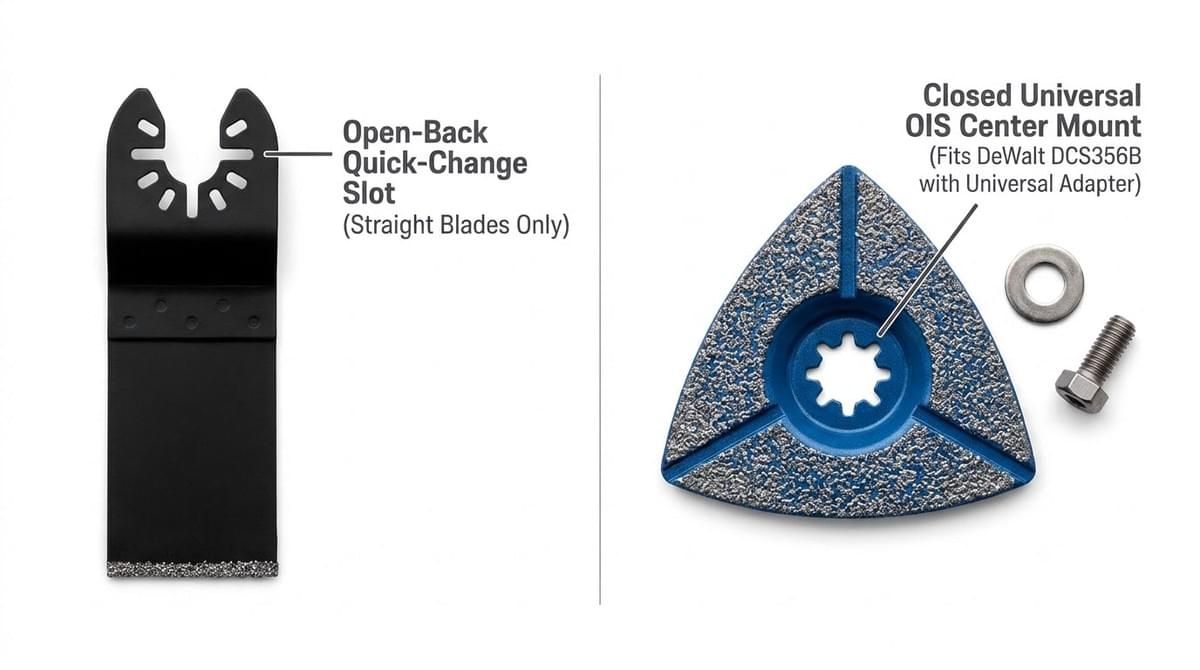
- Locate your DeWalt Universal Accessory Adapter (the small metal flange/washer and hex bolt included in the original DCS356B box).
- Seat the triangle pad onto the adapter pins so the closed OIS center ring sits flush inside the recessed center cup.
- Tighten the bolt securely with the hex key—making sure the bolt head sits below the diamond segment surface so it never drags on the concrete.
Jobsite Tip: If you lost the original DeWalt adapter kit from your DCS356B box, replace it before ordering closed-ring OIS triangle grinding pads.
Quick Multi-Tool Fitment Reference
Quick Multi-Tool Fitment Reference
- DeWalt DCS356B / DCS355 / DCS354 (Quick-Change Clamp): Fits closed universal OIS triangle pads — requires the DeWalt Universal Accessory Adapter included with the tool.
- Milwaukee M12 / M18 Multi-Tool (Tool-Free OIS / Bolt Clamp): Fits directly using the built-in OIS arbor / standard washer and bolt.
- Makita XMT03 / DTM51 (Non-Starlock OIS): Fits directly using the standard OIS clamp or adapter.
- Bosch & Fein (Starlock / StarlockPlus / StarlockMax): Uses a 3D Starlock cup — requires a Starlock-specific pad or adapter (confirm before ordering).
Still unsure about your mount? You can compare blade styles and check exact tool fitment directly on our Diamond Oscillating Tool Blades page before placing an order.
2. Sintered Metal Bond vs. Vacuum Brazed vs. Electroplated: Which Type Do You Need?
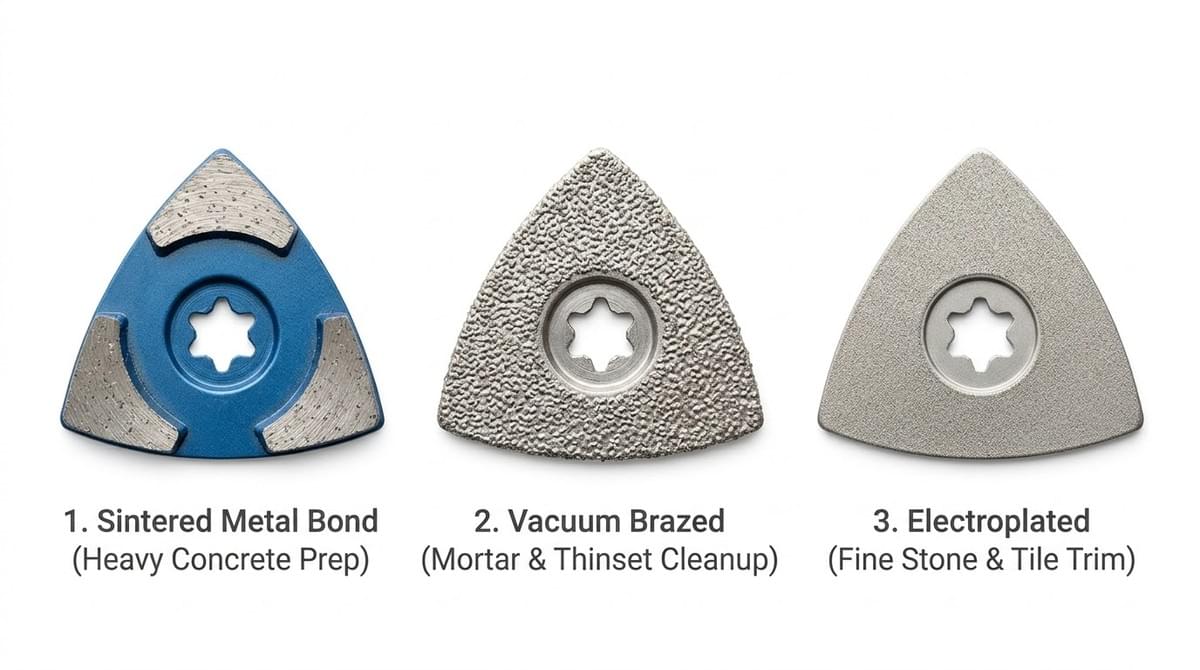
Quick Comparison of the 3 Diamond Constructions
1. Sintered Metal Bond (3-Segment Triangle)
- Build: Thick 3–5 mm metal-bond diamond segments welded onto a steel triangle base.
- Concrete Durability: Highest — wears gradually and keeps exposing fresh diamonds.
- Best For: Heavy concrete corner prep, leveling high spots, and opening edges for epoxy.
- Typical Grits: 30/40#, 60/80#.
2. Vacuum Brazed Triangle Blade
- Build: Single layer of coarse diamond grit brazed at high heat onto the steel face.
- Concrete Durability: Medium — aggressive initial bite, wears out once the top layer is gone.
- Best For: Mortar/thinset cleanup, tile adhesive removal, and light masonry edge work.
- Typical Grits: 30/40#, 60#.
3. Electroplated Triangle Blade
- Build: Ultra-thin single layer of nickel-plated fine diamond on the working face.
- Concrete Durability: Lowest on rough concrete — smooth cut with low vibration, strips fast on heavy slabs.
- Best For: Fine stone, marble, granite, and porcelain tile edge touch-ups and countertop corners.
- Typical Grits: 60#, 120#, 200#+.
When to Choose Each Type
- Choose Sintered Metal Bond (3-Segment Triangle) if you are a concrete floor contractor grinding bare concrete corners, removing lippage against walls, or prepping garage and commercial slab edges for coatings. Because the diamond is mixed throughout the entire thickness of the metal segment, it outlasts single-layer pads many times over.
- Choose Vacuum Brazed when you want fast, budget-friendly cutting for mortar cleanup, tile grout/thinset removal, or occasional masonry trimming where heavy slab life is not required.
- Choose Electroplated for precision stone, porcelain, or marble detail work where a thin, clean, low-chipping finish matters more than aggressive stock removal.
(Note: At Monkey King Diamond Tools, we supply heavy-duty sintered 3-segment triangle blades and are expanding our online lineup to include dedicated vacuum brazed and electroplated options. View current styles on our Diamond Oscillating Tool Blades page.)
3. The #2 Mistake: Picking the Wrong Grit & Bond for Your Application
A cordless oscillating tool like a 20V DeWalt DCS356B does not have the weight or horsepower of a 500-lb walk-behind concrete grinder. That changes how you pick your grit and bond:
Match Grit to the Job
- 30/40 Grit (Coarse): The go-to grit for concrete floor preparation—opening up bare concrete in corners, knocking down troweled high spots, and matching the scratch profile left by your walk-behind metal-bond diamonds before epoxy or densifier.
- 60/80 Grit (Medium): Ideal for refining 30-grit corner scratches, cleaning stubborn mortar/thinset near tile edges, and smoothing concrete edges prior to hybrid or resin transition steps.
- 120 Grit and Finer: Best for natural stone, terrazzo, and concrete countertop detail smoothing where coarse segments would leave deep gouges.
Why Bond Hardness Matters on Handheld Oscillating Tools
On a heavy floor grinder, contractors match hard concrete with soft bond and soft concrete with hard bond. On a handheld multi-tool, downward pressure is very light. If a sintered metal-bond triangle pad uses an overly hard matrix, the diamonds will glaze over and stop cutting.
For general U.S. commercial concrete prep with a handheld oscillating tool, start with a Medium Bond or Medium-Soft Bond in 30/40 grit—and let the tool’s high-frequency oscillation do the work instead of leaning hard on the head. Pressing too hard overheats the motor and drains batteries without grinding faster.
4. How Triangle Diamond Blades Fit Into a Complete Concrete Floor Prep Workflow
Smart concrete crews don’t use an oscillating multi-tool to grind open floor space—they use it as the final precision tool in a three-tier workflow:
- Main Floor Area: Run your planetary grinder with machine-matched metal bond tooling—such as our Lavina-compatible metal diamond grinding shoes or 2-bar rectangular metal grinding shoes. Explore full setups by machine on our Lavina Tooling and EDCO Tooling pages.
- Perimeter & Wall Edges: Switch to a 5-inch or 7-inch angle grinder with a diamond cup wheel (browse our Cup Wheels & Edge Grinding Tools directly in the Monkey King Diamond Tools Store).
- Tight 90° Corners, Door Jambs & Columns: Finish the last two inches with a 30-grit 3-segment sintered triangle diamond blade on your oscillating multi-tool so the entire slab has a uniform mechanical profile.
5. Ordering Tips: Trial Pieces vs. Contractor Bulk Orders
Before ordering specialized sintered diamond oscillating blades, keep one practical supply-chain point in mind:
- Standard stock vs. custom sintered runs: Heavy-duty sintered metal-bond triangle pads often require a minimum factory batch (commonly 12 pieces for custom grit/bond runs) to keep the diamond-and-metal powder blend uniform.
- For U.S. contractors & distributors: At Monkey King Diamond Tools, standard online orders to the United States include free shipping and import taxes included, and we support contractor bulk orders, repeat setups, and exact fitment checks.
Need Help Confirming Fitment or Pricing?
Visit our Diamond Oscillating Tool Blades page or message Stone directly on WhatsApp (+86 152 0179 8136) or [email protected] with:
- Your exact oscillating tool model (e.g., DeWalt DCS356B, Milwaukee M18, Fein Starlock)
- Your material and job (concrete corner prep, mortar cleanup, or stone trimming)
- Target grit and quantity needed
We’ll verify the exact mount and recommend the most cost-effective blade for your jobsite.