

Floor Flatness vs Floor Levelness Before Concrete Grinding: What Contractors Should Check First
Concrete grinding can correct high spots, remove surface material and improve some local irregularities, but it should not begin with the assumption that every uneven floor is a grinding problem.
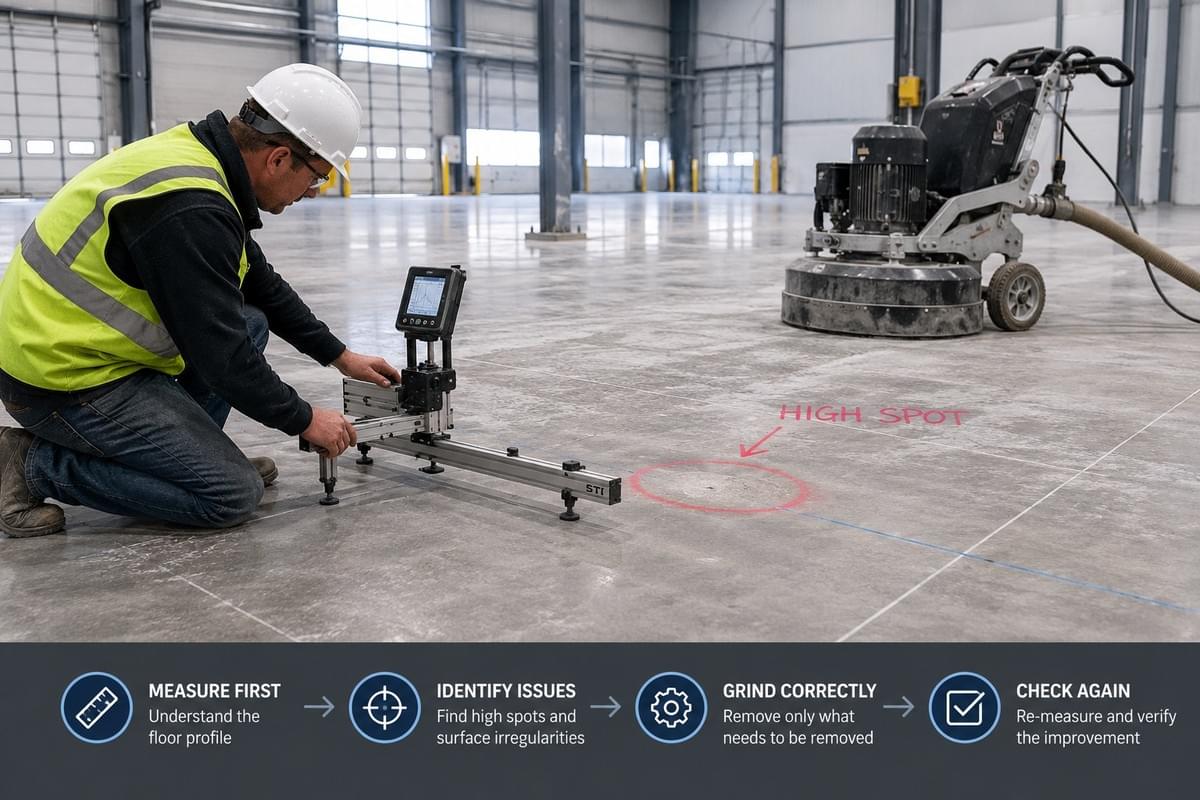
Floor Flatness and Floor Levelness Are Not the Same Thing
The terms are often used together, but they describe different characteristics of a concrete floor.
Floor flatness describes relatively short-distance variations in the surface profile. A floor can have waves, bumps or local high and low areas even when its overall elevation is reasonably correct.
Floor levelness relates more to longer-distance elevation changes and how the floor relates to its intended overall datum.
This distinction matters before grinding.
A grinder removes material. It can reduce a high area, but it cannot raise a low area. If the actual problem is an overall elevation error or a significant low area, simply grinding surrounding concrete may not be the correct solution.
What Do FF and FL Numbers Tell You?
ASTM E1155/E1155M is used to determine FF Floor Flatness and FL Floor Levelness numbers for applicable floor surfaces.
These measurements provide quantitative information about the floor profile rather than relying on a visual impression such as:
“the floor looks uneven.”
That difference is important.
A contractor may see a visible high point and immediately think that aggressive grinding is required. A measured floor profile may show that the actual condition is more complex.
The inspection stage and the grinding stage therefore serve different purposes:
Measurement identifies the condition. Grinding changes the surface.
One should not be used as a substitute for the other.
Where TR34 Enters the Discussion
TR34 is widely associated with industrial concrete floors and surface regularity requirements.
For contractors and tooling buyers, the important practical lesson is not to treat “TR34” as the name of a grinding process.
It is a floor specification and assessment context.
If a project has a stated TR34 requirement, the contractor needs to know:
- what surface-regularity requirement applies;
- how the floor will be measured;
- where the measured deviations occur;
- whether corrective grinding is permitted;
- and what condition must be achieved after corrective work.
Only after those questions are understood does tool selection become relevant.
When Can Concrete Grinding Help?
Grinding becomes useful when the measured or identified problem can actually be corrected by removing concrete from the high side of the profile.
Typical examples include:
- isolated high spots;
- ridges or raised transitions;
- localized surface irregularities;
- some slab joints or edges that stand proud of the surrounding surface;
- surface material that needs to be removed before another preparation stage.
For these jobs, appropriately selected metal bond grinding tools are commonly used for concrete cutting, slab opening and leveling work.
The correct diamond grit and bond still depend on the actual concrete condition. A tool that fits the machine mechanically is not automatically the correct tool for the slab.
When Is Grinding Not the Complete Solution?
Grinding should not be treated as a universal floor-leveling method.
Consider a simple example.
If an isolated area is too high, removing material from that area may be logical.
If a large area is too low relative to the required elevation, a grinder cannot add concrete back to the slab.
Likewise, if the project problem is related to:
- overall elevation;
- large depressions;
- structural movement;
- curling or deflection;
- specified surface tolerances that require professional measurement;
the contractor needs to determine the underlying condition before deciding on corrective work.
This is why “the floor is not level” is not enough information to select a diamond tool.
Measure First, Then Mark the Actual Grinding Areas
A practical corrective workflow is:
Measure → identify deviations → mark corrective areas → grind → measure again.
The first measurement tells the contractor where material may need to be removed.
The grinding stage then becomes controlled correction rather than blind material removal.
After grinding, the surface should be checked again according to the project requirements. Visual inspection alone does not establish compliance with an FF/FL or TR34 requirement.
This approach also reduces unnecessary grinding.
Removing concrete from an area that did not need correction wastes tooling, machine time and slab material.
Choosing the Starting Diamond Tool
Once grinding is confirmed as the appropriate corrective step, tool selection depends on several factors.
Concrete Hardness
Hard and soft concrete do not necessarily require the same bond.
On many hard floors, a softer bond helps expose fresh diamond as the tool wears. Softer concrete generally requires a harder bond to control tool wear.
Amount of Material That Must Be Removed
A small surface correction and an aggressive high-spot removal job should not automatically start with the same grit.
The deeper the correction, the more important it becomes to consider the scratch pattern that will remain after the first grinding step.
Machine System
The machine brand alone is not enough.
Confirm:
- machine model;
- grinding plate;
- mounting system;
- tool dimensions;
- required holder or adapter;
- and the actual job stage.
Contractors working across different grinder systems can review tools by machine system before confirming the mounting pattern.
Where a different tooling system needs to be used on an existing grinder, a suitable adapter or conversion plate may be required. Fitment should always be confirmed before ordering.
High-Spot Removal Is Only the First Part of the Tooling Decision
Aggressive grinding solves one problem but may create another: a coarse scratch pattern.
If the corrected floor will later be polished, the first grinding step should therefore be selected with the following stages in mind.
A typical refinement path may move from:
metal bond grinding → transition → resin polishing
The exact sequence depends on the floor and target finish.
After the required geometry has been corrected, hybrid transition pads can be used where appropriate to refine metal scratches before moving into later polishing stages.
This is different from flatness correction itself.
A hybrid or resin pad should not be expected to perform the same aggressive high-spot removal work as an appropriate metal grinding tool.
What If the Floor Will Receive a Coating Instead of a Polish?
The objective changes again.
For a coating project, the contractor may not need to polish away the grinding pattern. Instead, the goal may be to achieve the required floor geometry and create a suitable surface condition for the coating system.
Coating requirements should therefore be considered before choosing the final grinding step.
Do not continue through polishing grits simply because they are part of a standard polishing sequence if the actual project ends with a coating.
The required surface profile for the specified coating system should control the preparation process.
What Contractors Should Check Before Ordering Grinding Tools
Before purchasing diamonds for a floor-correction job, confirm at least:
- What was actually measured?
- Is the problem flatness, levelness or a local high spot?
- Where are the areas that require material removal?
- How much concrete needs to be removed?
- What is the concrete hardness?
- What grinder and grinding plate are being used?
- What mounting system is required?
- What comes after grinding: coating, further refinement or polishing?
- Does the project require another formal floor measurement after correction?
These questions are more useful than simply asking:
“What grit should I use for leveling?”
The Key Principle: Inspection and Grinding Are Different Jobs
Professional floor inspection tells you where the problem is and how the surface compares with the project requirement.
Diamond grinding tells you how material can be removed once corrective grinding has been determined to be appropriate.
Keeping those two jobs separate prevents a common mistake: selecting an aggressive grinding tool before understanding what the floor actually needs.
At Monkey King Diamond Tools, our role is on the tooling side. We supply diamond tools for concrete grinding, floor preparation, coating removal, transition and polishing.
If corrective grinding is required, start with the measured floor condition, machine model, grinding plate, concrete hardness and target result. That information makes it much easier to select the appropriate tooling without treating every uneven floor as the same problem.