

Short answer
Yes, cap cutters can improve absorption on dense concrete better than many standard grinding tools.
But on some dense, hard-troweled slabs, planetary grinding alone may still not open the capillary structure enough for strict penetrating sealer absorption requirements.
In those cases, shot blasting may be needed for consistent results.
This article is based on a real jobsite test using a planetary floor grinder, Redi-Lock style cap cutters, and a penetrating sealer absorption requirement.
The field problem
Some concrete slabs look open after grinding, but still do not absorb liquid fast enough.
That is the problem.
A contractor may grind the floor, see exposed sand or aggregate, and assume the surface is ready. But when a penetrating sealer absorption test is performed, water or sealer can still bead on the surface.
That means the slab may have surface profile, but the capillary structure is still not open enough.
For penetrating sealers, those two things are not always the same.
- Surface profile means the floor has been mechanically scratched or textured.
- Capillary opening means liquid can actually absorb into the concrete.
A slab can look open and still fail absorption.
What was tested
In this field test, a contractor spent about six hours grinding a 700 sq ft concrete slab.
The goal was to prepare the slab for a penetrating sealer system that required consistent absorption.
The test included:
- A planetary floor grinder
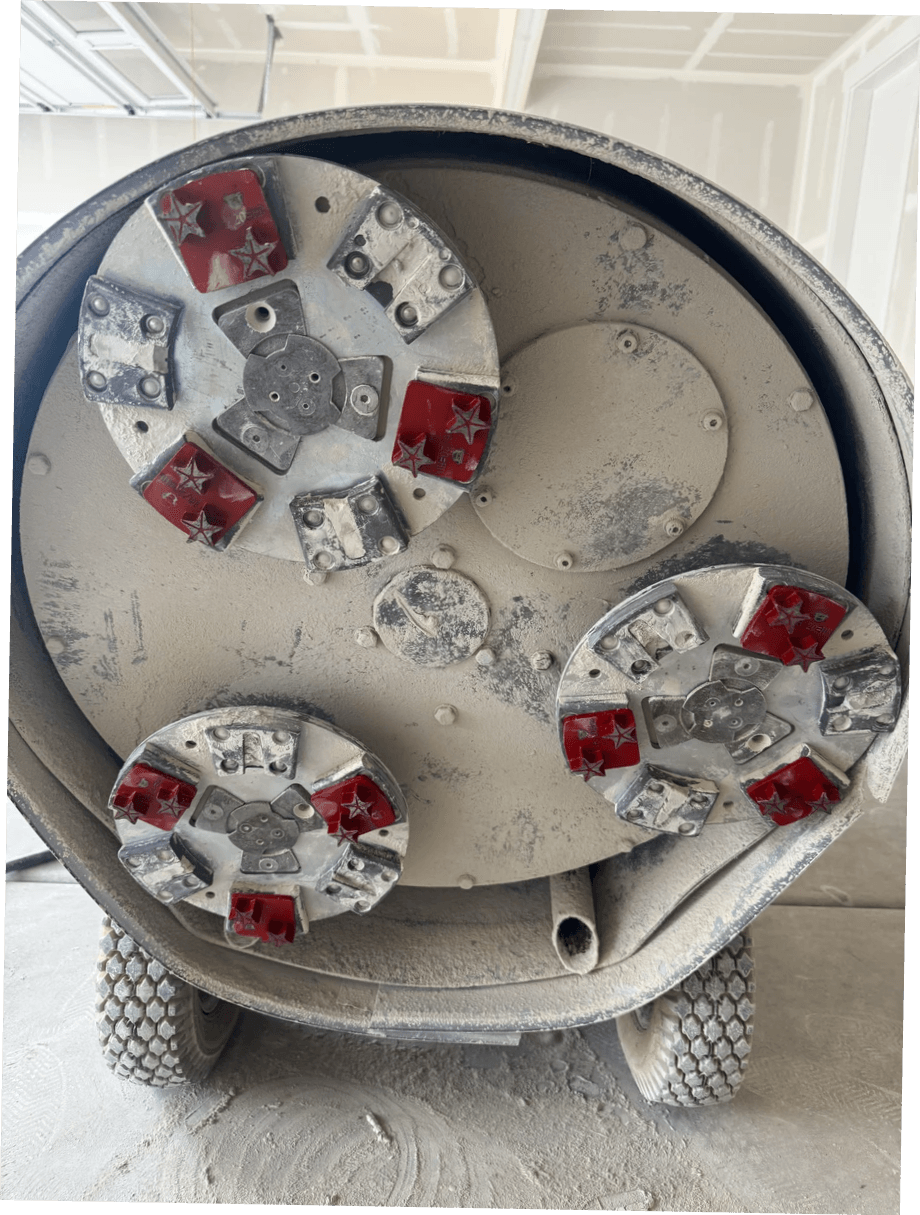
- Redi-Lock style slide-on tooling
- 16/20 hard bond cap cutters
- Standard metal grinding tools
- Multiple tooling combinations
- Multiple passes
- Repeated absorption testing
The tools were installed using an adapter plate setup that allowed the grinder to run Redi-Lock style slide-on tooling.
Related product:
Husqvarna Redi-Lock Cap Cutters 16/20 Hard Bond:
https://www.monkeykingdiamond.com/store/products/husqvarna-redi-lock-cap-cutter-1620-hard-9pcs
For machine conversion and slide-on tooling setups, see:
Adapter Plates:
https://www.monkeykingdiamond.com/adapters-plates
What worked
The adapter plate worked well.
It allowed the grinder to use the slide-on tooling correctly, which solved the tooling compatibility issue.
The cap cutters also worked better than the other tooling combinations tested.
Compared with standard grinding diamonds, the cap cutters improved absorption more effectively. That means they were doing what they are designed to do: break through a tight surface cap more aggressively than standard grinding segments.
For dense slabs with a shiny cap, curing film, or burnished surface, cap cutters can be a practical first step.
More Husqvarna-compatible tooling:
https://www.monkeykingdiamond.com/husqvarna
What did not work
The cap cutters improved absorption, but they did not fully solve the problem across the whole slab.
After about six hours on a 700 sq ft slab, the contractor still could not achieve consistent absorption across the full area.
The surface improved, but reaching exposed aggregate everywhere would have required pass after pass after pass.
At that point, the practical conclusion was clear:
The cap cutters helped identify the limit of the method, but planetary grinding alone was not enough for this slab.
Why planetary grinding may not be enough
Planetary grinding removes material through rotating diamond tools.
It can flatten, scratch, profile, and cut the surface. With the right tooling, it can also break through a tight surface cap.
But on very dense or hard-troweled concrete, the surface may not open evenly.
Some areas may absorb better. Other areas may remain tight.
That creates an inconsistent result.
For many coatings or sealers, a surface profile may be enough. But for strict penetrating sealer absorption, the surface must allow liquid to absorb consistently across the working area.
That is a higher requirement.
For standard grinding and profiling tools, see:
Metal Bond Grinding Tools:
https://www.monkeykingdiamond.com/metal-bond-grinding-tools
For coating and heavy removal stages, see:
PCD Coating Removal Tools:
https://www.monkeykingdiamond.com/pcd-coating-removal
When cap cutters make sense
Cap cutters make sense when:
- Standard 16/20 metal diamonds are skating
- The slab has a shiny or tight surface cap
- The surface looks closed after grinding
- A curing film or burnished layer needs to be broken
- You want to test whether grinding can open the slab before moving to shot blasting
- You need more aggressive surface opening than standard metal segments
Cap cutters are not just another grit number.
Their shape and contact pattern can create more cutting pressure on the surface, which helps them attack the top cap more aggressively.
When shot blasting may be needed
Shot blasting may be needed when:
- Absorption must be consistent across the entire slab
- The concrete is very dense or hard-troweled
- Grinding improves absorption but does not make it consistent
- The floor requires too many passes with diamond tooling
- The project has a strict penetrating sealer requirement
- The contractor needs a repeatable preparation method
Shot blasting impacts the surface differently from grinding.
Instead of relying only on rotating diamond contact, shot blasting mechanically impacts the concrete surface and can open certain dense slabs more consistently.
That is why shot blasting may be the better method when absorption is the real pass/fail requirement.
Practical jobsite recommendation
For dense concrete that must pass a penetrating sealer absorption test:
- Start with the sealer manufacturer’s required test method.
- Test a small area first.
- Use cap cutters if standard metal diamonds skate or fail to open the surface.
- Clean the surface fully before testing absorption.
- Do not rely only on how the surface looks.
- If absorption improves but remains inconsistent, consider shot blasting.
- Record the tooling, number of passes, cleaning method, and test result.
The goal is not just to make the concrete look ground.
The goal is to make the concrete absorb consistently.
Tooling used in this test
The field test used Redi-Lock style 16/20 hard bond cap cutters on a planetary floor grinder.
Related tools:
Husqvarna Redi-Lock Cap Cutters 16/20 Hard Bond:
https://www.monkeykingdiamond.com/store/products/husqvarna-redi-lock-cap-cutter-1620-hard-9pcs
HTC to Husqvarna Redi-Lock Adapter Plate:
https://www.monkeykingdiamond.com/store/products/htc-to-husqvarna-redi-lock-adapter-plate-for-floor-grinders
Husqvarna-Compatible Diamond Tools:
https://www.monkeykingdiamond.com/husqvarna
Adapter Plates:
https://www.monkeykingdiamond.com/adapters-plates
Metal Bond Grinding Tools:
https://www.monkeykingdiamond.com/metal-bond-grinding-tools
PCD Coating Removal Tools:
https://www.monkeykingdiamond.com/pcd-coating-removal
Main Website:
https://www.monkeykingdiamond.com
FAQ
Can cap cutters improve concrete absorption?
Yes. Cap cutters can improve concrete absorption by breaking through a tight surface cap more aggressively than standard grinding diamonds. In this field test, cap cutters improved absorption more than the other tooling combinations tested.
Can cap cutters replace shot blasting?
Not always. Cap cutters can improve the surface, but on some dense or hard-troweled slabs, shot blasting may still be needed to achieve consistent absorption across the full area.
Why did the slab still fail absorption after grinding?
The slab likely had a dense or burnished surface structure that planetary grinding could not open evenly. Some areas may have opened, while other areas remained too tight to absorb consistently.
Does exposed aggregate always mean the slab is ready?
No. Exposed aggregate does not always mean the capillary structure is open enough for a penetrating sealer. Absorption testing is still needed.
Should I use hard bond or soft bond cap cutters?
It depends on the slab. Hard bond cap cutters can work on some surfaces. If the tool skates on very dense concrete, a softer bond may expose diamond faster and bite better. Always test a small area first.
When should I move from grinding to shot blasting?
Move to shot blasting when grinding requires too many passes, absorption remains inconsistent, or the project needs a repeatable preparation result across the whole slab.
What is the main lesson from this test?
The main lesson is that cap cutters can help, but they also help reveal the limit of planetary grinding. If the slab still cannot absorb consistently after aggressive grinding, the problem may require shot blasting instead of more passes.