

How to Choose the Right PCD for a Floor Project
How to Choose the Right PCD for a Floor Project
A practical guide to matching PCD tools to glue, mastic, epoxy, floor hardness, and machine system.
Choosing the right PCD for a floor project is not just about buying “a PCD tool.” It is about matching the tool to the material being removed, the concrete condition, and the machine system. That is where many coating removal problems start. A tool that works well on one floor can feel too slow, wear too fast, or leave a rough result on another.
If a contractor says, “This PCD did not last,” or “It did not cut the way it should,” the first question should not be about price. The first question should be: Was this the right PCD for this job in the first place?
If you are selecting tools for coating removal, start with the basics first. Our PCD & Coating Removal page shows the main tool category, and our Surface Preparation Tools page gives a broader view of prep-stage tooling before grinding or polishing.
1) Start with the material you need to remove
This is the biggest decision point. Different materials need different PCD logic.
Carpet glue and adhesive residue
Carpet glue removal is often where contractors make the wrong choice. Some glue is dry and brittle. Some is soft, sticky, or smears under heat. Those are not the same job.
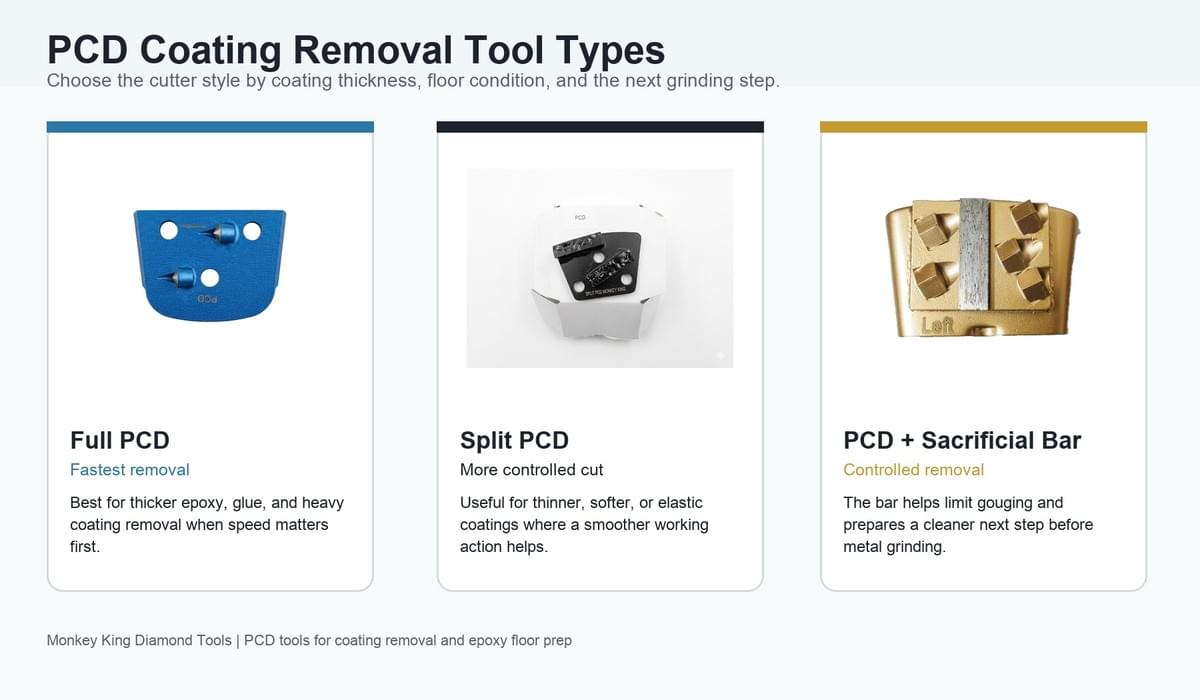
For light to moderate carpet glue residue, a more controlled PCD setup often works better than an overly aggressive test-style tool. In many cases, a double PCD with a support bar or metal segment gives a more stable cut and cleaner removal pattern.
For thick, soft, sticky mastic or heavy adhesive, the problem may not be “bad PCD quality.” The real problem may be that the job calls for a different removal structure. If the glue is smearing, loading up, or acting rubbery, the contractor may need a more specialized removal setup instead of repeating the same PCD style again.
If your main work is glue and adhesive removal, review the options in our PCD & Coating Removal section before repeating the same tool on every floor.
Epoxy coating removal
Epoxy is different from carpet glue. Some epoxy systems are thin and brittle. Others are thick, hard, and strongly bonded. A PCD that feels acceptable on glue may feel too mild on epoxy. On the other hand, an aggressive coating-removal PCD can be excessive for lighter residue or leave a rougher profile than needed.
For hard-bonded epoxy on concrete, contractors often need a stronger coating-removal PCD structure than they would use for ordinary glue residue. This is especially true when the slab itself is dense and the coating bond is strong.
Paint, sealer, and thin surface contamination
Not every removal job needs the most aggressive PCD. If the floor has only thin paint, light sealer residue, or minor contamination, the goal may be controlled removal and surface opening, not maximum attack. In those cases, the wrong aggressive tool can waste tool life and create unnecessary scratch or profile issues.
2) Check the concrete hardness before blaming the tool
The same PCD can behave very differently on different slabs.
Hard concrete
On hard concrete, a PCD can feel less aggressive than expected. That does not always mean the tool is defective. It may mean the floor is dense, the coating is strongly bonded, or the selected PCD structure is not aggressive enough for that combination.
For hard concrete plus epoxy, it usually makes sense to move toward a more aggressive coating-removal setup rather than simply repeating a lighter glue-removal style.
Medium concrete
Medium concrete is where more PCD styles can work reasonably well, but “reasonably well” is not the same as “most efficient.” If the project is large, even small differences in cut speed and consistency matter.
Soft or more open concrete
On softer concrete, some aggressive PCD structures may remove coating quickly but also create a rougher profile than necessary. Tool choice should match not only removal speed, but also what needs to happen next. If the floor will move into grinding, transition, or polishing, that next step matters.
If you want to see how prep-stage choices connect to later grinding steps, our workflow content such as A Practical Scanmaskin Coating Removal Workflow: From Double PCD to Metal to Ceramic is a useful reference point.
3) Choose the PCD structure by job type, not by habit
One of the most common mistakes in floor prep is using the same PCD style for every project.
When a more controlled PCD makes sense
A more controlled structure is often better when:
• the coating is not extremely thick
• the contractor wants more predictable removal
• the floor should stay easier to manage for the next grinding step
• glue residue is present, but not extremely heavy or rubbery
When a more aggressive PCD makes sense
A stronger, more aggressive coating-removal structure is usually better when:
• epoxy or coating bond is strong
• the slab is hard and dense
• the goal is faster removal of tougher material
• the contractor accepts a rougher prep pattern in exchange for speed
When the answer is not “just another PCD”
Sometimes the most professional answer is not to keep changing from one random PCD to another. If the material is thick, sticky, soft, and keeps smearing, the issue may be that the application itself needs a different removal approach. That is why tool selection should start from job condition, not from old purchase history.
4) Machine system matters more than many buyers expect
Even if the PCD structure is correct, the wrong fitment can still ruin the result.
A Lavina setup and a Diamatic or Blastrac trapezoid setup are not just different holders. Machine system, rotation behavior, and fitment all affect how a PCD performs on the floor. That is why a contractor should confirm the machine family before reordering.
You can start by checking your grinder system here:
• Lavina compatible tools
• Diamatic / Blastrac compatible tools
• More machine-compatible tooling
If the project involves multiple grinders or mixed fleets, it is usually smarter to build the selection by machine family first, then finalize the PCD style.
5) Ask these 5 questions before ordering PCD tools
Before choosing a PCD for a project, answer these five questions:
1. What exactly are you removing?
Is it carpet glue, mastic, epoxy, paint, sealer, or mixed coating residue?
2. How thick and sticky is it?
Thin residue and heavy sticky glue are not the same application.
3. What is the slab like?
Is the concrete hard, medium, or soft? Is it dense and polished-looking already, or more open and porous?
4. What machine are you using?
Lavina, Diamatic, Blastrac, Scanmaskin, HTC, Husqvarna, SASE, Terrco, or another system?
5. What happens after removal?
Will the floor go into metal grinding, transition, polishing, or recoating? The next step changes what “best PCD choice” means.
That is also why many contractors do better when they think in systems, not single tools. At Monkey King Diamond, we build tooling around coating removal, grinding, transition, polishing, and machine fitment together. You can see that approach on our About Monkey King Diamond page and across our product categories.
6) Signs you probably chose the wrong PCD
A wrong PCD choice often shows up in one of these ways:
• it cuts, but much slower than expected
• it wears faster than expected
• it smears glue instead of removing cleanly
• it feels unstable across the floor
• it leaves a surface pattern that creates extra work later
• it works on one project but performs badly on another “similar” floor
When that happens, many buyers assume the tool quality is bad. Sometimes that is true. But very often the real issue is mismatch: the wrong PCD for the material, the slab, or the machine.
7) A simple way to choose better on the next order
A practical decision path looks like this:
Glue or adhesive residue?
Start with a glue-removal-focused PCD setup, not a generic “one style fits all” choice.
Hard concrete + bonded epoxy?
Move toward a stronger, more aggressive coating-removal setup.
Very sticky, thick, smearing material?
Do not keep forcing the same test-style PCD. Reassess the removal structure before buying again.
Multiple machine systems?
Separate the fitment first, then confirm the removal structure for each machine.
Final thought
The right PCD is not chosen by shape alone. It is chosen by the relationship between material, floor condition, machine system, and next process step.
That is why the best question is not, “Which PCD sells the most?”
The better question is: Which PCD makes sense for this exact project?
If you are planning a coating removal job and want to reduce trial and error, start from the application, then match the tool. You can explore our Surface Preparation Tools, review our PCD & Coating Removal solutions, or contact us through Monkey King Diamond for a machine- and job-based recommendation.
Related pages: