

PCD vs Metal Bond Grinding Tools: Which One to Use?
PCD vs Metal Bond Grinding Tools: Which One to Use?
A practical guide to choosing PCD tools for coating removal and metal bond tools for concrete grinding, slab opening, and scratch control.
A simple way to decide is this: use PCD tools when the job is floor coating removal, and use metal bond tools when the job is grinding of concrete after the surface is already open.
For product selection, start with PCD coating removal tools when the floor has epoxy, glue, mastic, paint, or thick coating. Use metal bond grinding tools when the coating is removed and the job moves into slab opening, leveling, or scratch control. If the floor will be polished later, use hybrid pads before moving into resin polishing pads.
Opening
Contractors often ask the same question at the start of a job: should the first step be PCD tools or metal bond grinding tools? The answer depends on what is actually on the floor. These two tool types are not interchangeable, and choosing the wrong one can waste time, increase tool wear, and create unnecessary extra steps later.
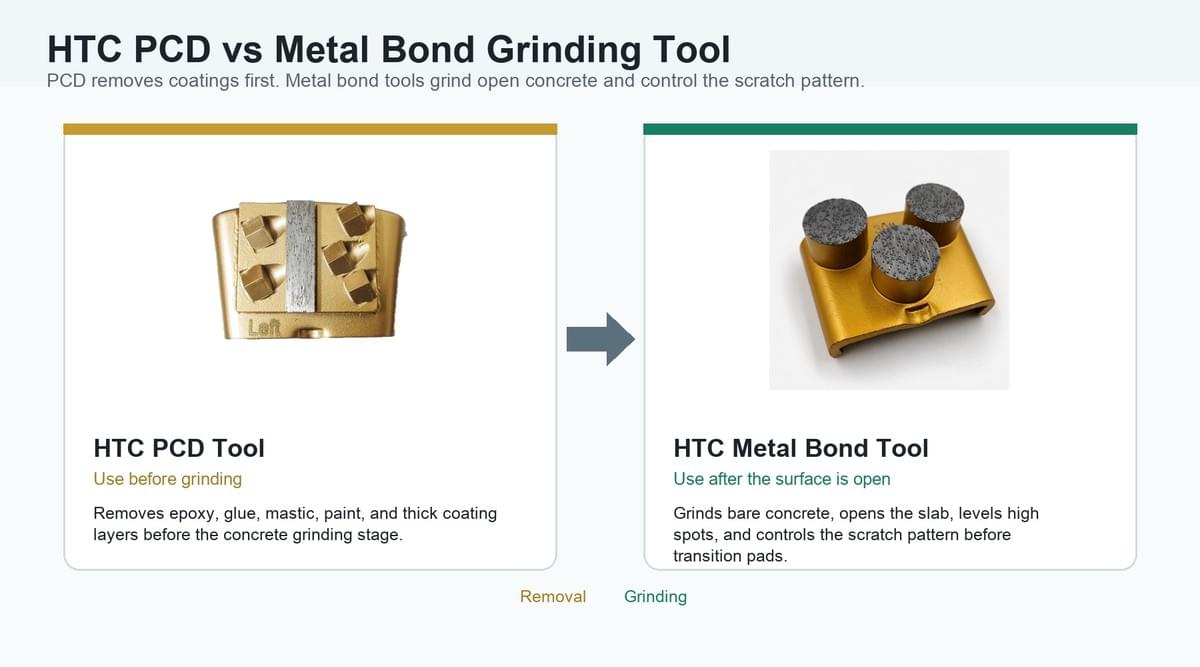
What PCD Grinding Tools Are Used For
PCD grinding tools are mainly used for aggressive coating removal. They are commonly chosen for jobs involving:
- epoxy coatings
- glue residue
- mastic
- paint
- thick surface contamination
The main purpose of PCD is to strip surface material quickly and expose the concrete underneath. PCD is not designed to leave a refined floor. Its job is fast removal.
What Metal Bond Grinding Tools Are Used For
Metal bond grinding tools are mainly used for concrete grinding, slab opening, scratch control, and surface preparation.They are commonly used for:
- opening the slab
- removing high spots
- leveling uneven concrete
- controlling scratch patterns
- preparing the floor for transition or polishing stages
If the floor is already bare concrete, metal bond tools are usually the better starting point.
When Contractors Should Start with PCD Tools
PCD tools are a better first step when the floor has a real surface layer that needs to be removed before grinding can begin. This includes thick coatings, adhesives, or contamination that would quickly load up ordinary grinding tools. In this stage, the goal is removal, not refinement.
When Contractors Should Start with Metal Bond Tools
Metal bond tools are a better first step when the floor is already open or mostly bare concrete. In these cases, the contractor usually needs grinding, leveling, scratch control, or polishing preparation rather than aggressive coating removal.
Why the Difference Matters
Starting with the wrong tool creates problems. If contractors use metal bond tools on a floor with heavy epoxy or glue, the tools may load up, wear inefficiently, and slow the whole process. If contractors use PCD on a floor that only needs ordinary grinding, the floor may become rougher than necessary and require more correction later.
A Practical Jobsite Workflow
In many real jobs, the right answer is not PCD or metal bond. It is a sequence:
- PCD for coating removal
- coarse metal bond tools for slab opening
- medium metal bond tools for scratch control
- hybrid or resin tools if polishing is needed
This is why experienced contractors usually think in systems, not single tools.
How Monkey King Diamond Supports Both Stages
At Monkey King Diamond, we supply both PCD grinding tools and metal bond grinding tools for different machine systems and floor preparation needs. The right choice depends on machine brand, concrete condition, coating thickness, and the final project target.
Closing
PCD grinding tools and metal bond grinding tools serve different purposes. PCD is for aggressive removal. Metal bond tools are for grinding, leveling, and surface preparation. When contractors match the first tool to the real floor condition, the whole workflow becomes faster, cleaner, and more predictable.
Related Pages