

What Are Transitional Pads for Concrete Grinding?
Transitional pads are diamond tools used between metal bond grinding and resin polishing.
Their main job is to reduce the scratch pattern left by metal grinding tools and prepare the concrete for a smoother move into the resin polishing stages.
The practical workflow is:
Metal bond grinding → transitional pads → resin polishing
A transitional pad is not automatically required on every floor. It becomes useful when the metal grinding stage is complete, but the remaining scratches are still too deep or too visible for resin pads to remove efficiently.
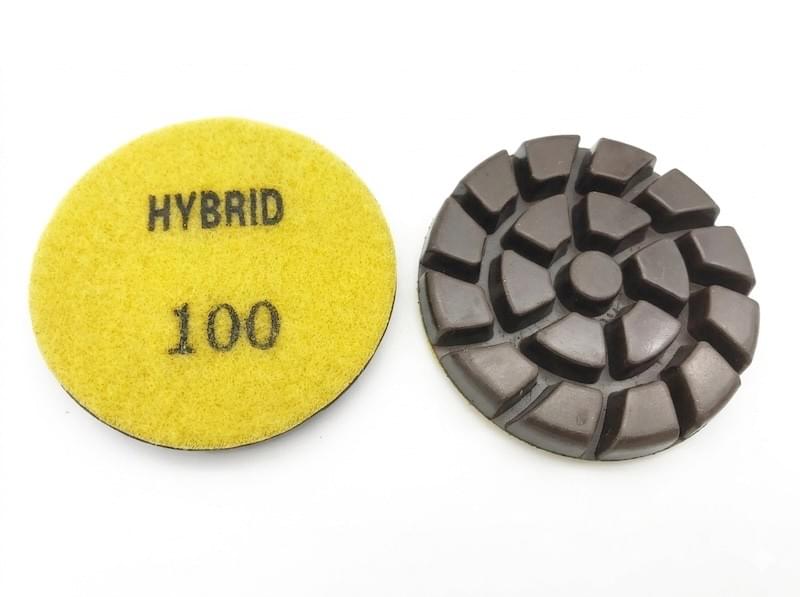
Looking for hybrid transitional pads for your next concrete polishing project?
Explore available sizes and grits, then order directly from our online store:
Why Are Transitional Pads Needed?
Metal bond grinding tools are designed for cutting, opening, leveling, and correcting concrete.
That aggressive cutting action usually leaves a visible scratch pattern.
Resin pads are softer and are intended for later-stage refinement, clarity, and gloss. If the operator moves directly from an aggressive metal tool into resin before the metal scratches are controlled, several problems may appear:
- deep scratches remain visible;
- resin pads wear faster;
- extra polishing steps are required;
- the floor becomes shiny but still shows lines or swirls;
- different areas develop uneven reflection.
Hybrid transition pads create a controlled bridge between the two stages.
They retain enough cutting ability to work on the remaining metal scratches while leaving a finer surface than a conventional metal bond tool.
When Should You Use a Transitional Pad?
Use a transitional pad when:
- the concrete has already been opened and leveled;
- the metal grinding pattern is generally even;
- deep random cuts have been removed;
- visible metal scratches still remain;
- the floor is not yet ready for resin polishing;
- direct use of resin pads would require too much time.
Do not move into the transition stage simply because a metal grinding pass has been completed.
The correct time to change tools is when the previous stage has completed its job across the full working area.
When Should You Stay With Metal Bond Tools?
Remain in the metal stage when:
- high spots or uneven areas remain;
- the slab still needs material removal;
- deep PCD or coarse-metal scratches are present;
- the floor has not been opened consistently;
- coating residue is still visible;
- the scratch pattern varies significantly across the floor.
A transitional pad should not be expected to flatten a floor or correct unfinished structural grinding.
If the slab still needs aggressive correction, continue with the appropriate metal bond grit before moving forward.
Copper Transitional Pads
Copper bond transitional pads are commonly used when the floor still needs a relatively strong cutting action after metal grinding.
They can provide a balance between:
- metal scratch removal;
- controlled cutting;
- smoother surface refinement;
- preparation for resin polishing.
Copper transition tools may be suitable when:
- the previous metal grit left a noticeable scratch;
- the floor needs a stronger first transition step;
- direct ceramic or resin polishing would be too slow;
- the contractor wants a practical bridge between metal and resin.
Copper bond should not be selected from the product name alone. The required grit, wet or dry process, machine pressure, and concrete condition still need to be confirmed.
Ceramic Transitional Pads
Ceramic transitional pads are generally considered when the floor is already under better control and the objective is cleaner scratch refinement.
They may be suitable when:
- the aggressive metal scratches have mostly been removed;
- the remaining pattern is lighter and more uniform;
- the next stage will be resin polishing;
- the contractor wants a smoother transition rather than stronger stock removal.
Ceramic pads are not automatically better or finer than every copper pad.
The actual performance depends on:
- bond formulation;
- segment design;
- grit;
- machine weight;
- concrete hardness;
- wet or dry operation.
What Does “Hybrid Transitional Pad” Mean?
“Hybrid” is a broad term used for tools that sit between conventional metal grinding and resin polishing.
A hybrid transitional pad may use:
- copper bond;
- ceramic bond;
- metal-resin construction;
- another mixed or transitional bond design.
The important question is not only what the pad is called.
The more useful questions are:
- What scratch was left by the previous tool?
- How much cutting is still required?
- What surface must be produced before resin polishing?
For a more detailed comparison, review Copper Bond vs Iron Bond vs Ceramic Hybrid Pads.
How Do You Choose the Starting Grit?
The starting transitional grit should be selected according to the previous metal step and the depth of the remaining scratches.
A coarse transition grit is considered when:
- the previous metal stage was aggressive;
- visible scratches still require stronger correction;
- the floor needs a firmer bridge before finer polishing.
A finer transition grit is considered when:
- the metal scratch is already controlled;
- the surface is reasonably uniform;
- the goal is refinement rather than additional cutting.
Do not assume that a 50-grit metal tool, a 50-grit transitional pad, and a 50-grit resin pad perform the same job.
The grit number may be similar, but the bond and tool construction create different cutting behavior.
Should Transitional Pads Be Used Wet or Dry?
Wet or dry use depends on the specific transitional pad.
Do not assume that every copper, ceramic, or hybrid tool can be used in both conditions.
Before use, confirm:
- manufacturer or supplier instructions;
- wet or dry bond;
- machine speed;
- recommended pressure;
- dust or slurry control;
- holder and backing system.
Using a wet-only tool dry, or a dry-only tool wet, can reduce cutting performance, shorten tool life, or create an inconsistent finish.
Does the Machine Connection Matter?
Yes.
Transitional pads may use:
- Velcro backing;
- quick-change holders;
- foam rings;
- machine-specific locking systems;
- full polishing wheels.
Before ordering, confirm:
- machine brand and model;
- holder diameter;
- pad diameter;
- tool connection;
- required quantity;
- wet or dry process;
- working speed.
A pad with the correct grit and bond is still unusable if the connection does not match the grinder.
A Practical Concrete Polishing Workflow
A typical workflow may look like this:
Step 1: Complete Metal Grinding
Use the required metal bond tools until the slab is open, level, and free from deep random scratches.
Step 2: Inspect the Scratch Pattern
Check the floor under good lighting.
Do not judge only from one small area.
Look for:
- circular scratches;
- deep isolated lines;
- poorly ground edges;
- high spots;
- uneven exposure.
Step 3: Use the Transitional Pad
Choose the transitional bond and grit according to the scratch that still needs to be removed.
The transitional step should leave a more uniform and refined pattern.
Step 4: Recheck Before Moving Forward
If visible metal scratches remain, repeat or adjust the transition stage.
Do not move forward simply because the floor feels smoother.
Step 5: Begin Resin Polishing
Move into resin polishing pads only after the transition stage has produced a consistent surface.
Common Transitional Pad Mistakes
Moving Into Resin Too Early
A resin pad may brighten the surface without removing the deeper metal scratch underneath.
Expecting Transitional Pads to Level the Floor
Transition tools refine scratches. They are not a substitute for unfinished metal grinding or floor leveling.
Choosing Only by Grit Number
The same grit number can behave differently in metal, copper, ceramic, hybrid, and resin bonds.
Ignoring Wet or Dry Requirements
The wrong operating method can reduce cutting performance and pad life.
Using the Wrong Holder
A Velcro pad, quick-change puck, and full polishing wheel are not interchangeable.
Skipping Cleaning Between Steps
Metal particles or abrasive debris left on the floor can create new scratches during the next stage.
Transitional Pad Selection Checklist
Before selecting a transitional pad, confirm:
- What was the final metal grit?
- What scratches remain?
- Is the floor flat and evenly opened?
- Is stronger cutting or lighter refinement required?
- Is the process wet or dry?
- What grinder and holder are being used?
- What pad diameter is required?
- What resin grit will follow?
- What finish is the project targeting?
Are Transitional Pads the Same as Resin Pads?
No.
Transitional pads retain more cutting ability and are used to refine the scratch pattern left by metal tools.
Resin pads are intended for later polishing, clarity, and gloss development.
Are Transitional Pads Always Required?
No.
Some floors and tooling systems may allow a direct move from a sufficiently fine metal stage into resin.
However, transitional pads are useful when direct resin polishing cannot remove the remaining metal scratches efficiently.
Which Is Better: Copper or Ceramic Transitional Pads?
Neither is universally better.
Copper is considered when stronger scratch removal is still required.
Ceramic is considered when the floor is already controlled and needs cleaner refinement.
The correct choice depends on the actual scratch pattern and workflow target.
Can Transitional Pads Remove Coatings?
They are not the normal first choice for coating removal.
Epoxy, glue, paint, and mastic should generally be removed with suitable PCD or coating-removal tooling before the metal and transition stages begin.
Final Recommendation
A transitional pad should be chosen according to the problem left by the metal grinding stage.
Use a stronger transitional tool when the scratch pattern still needs meaningful correction.
Use a finer or more refinement-focused transitional tool when the surface is already controlled and nearly ready for resin polishing.
Do not choose only by grit number or product color.
When the previous metal grit, scratch pattern, concrete condition, or machine connection is unclear, send the grinder model, floor photographs, last completed grit, and target finish through Contact Us before ordering.